

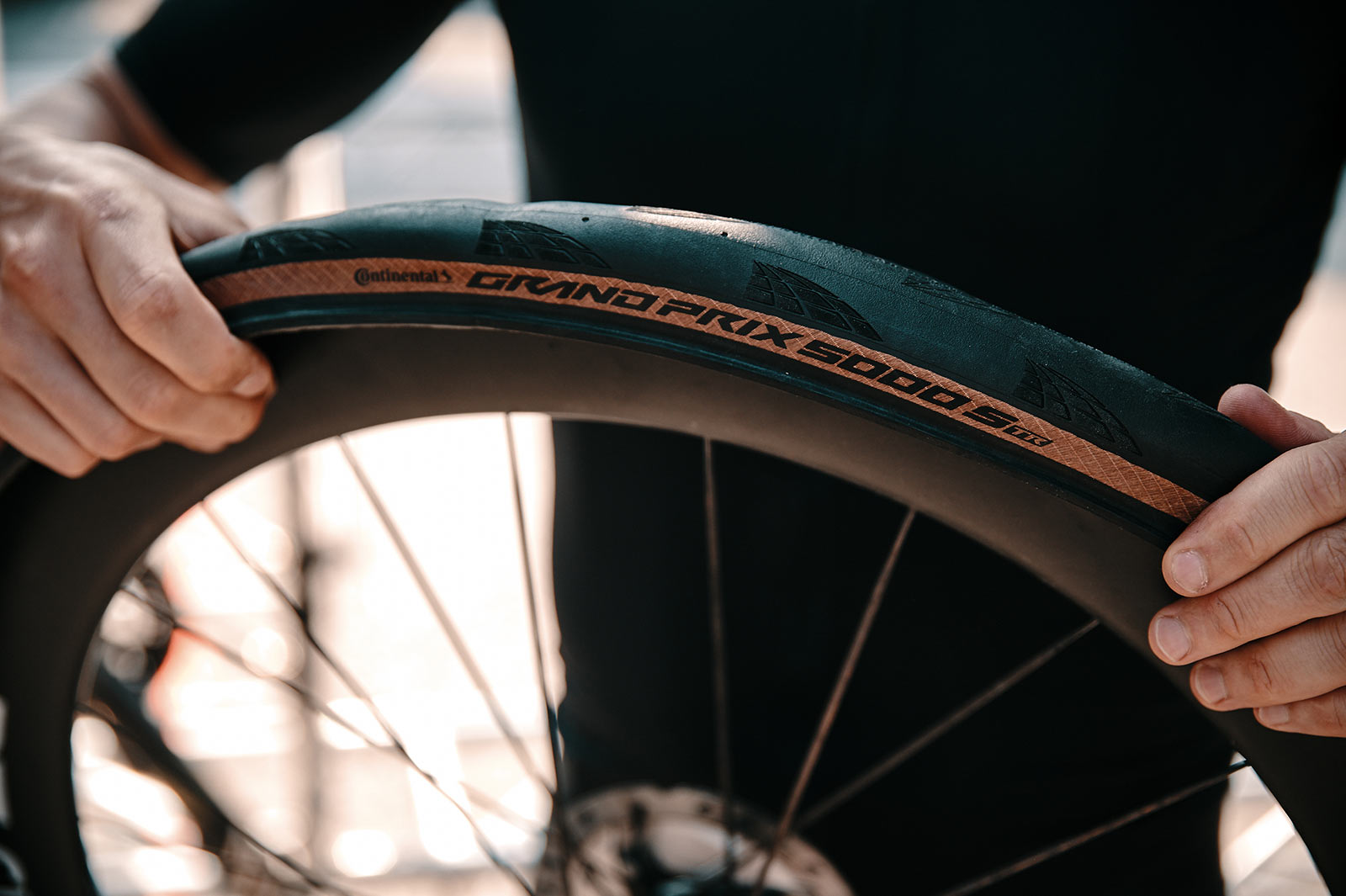
What should you pay attention to when choosing bicycle tires?
The tires of your bicycle are without a doubt one of the most important parts. They affect your performance, driving comfort and safety. A cheap bike with good tires and the correct tire pressure sometimes rides better than an expensive bicycle with the wrong tires. In this article we will take a closer look at tires for racing bikes. Characteristics of racing tires are the narrow profile and a smooth driving surface. This combination ensures lower rolling resistance and therefore better performance on the bike.

Bandwidth
As a rule, the narrower the width of the bicycle tire, the less resistance there is to the ground. So the faster you go. The width of bicycle tires varies from 19 to 100 mm. In which the thinnest tires for track cycling are used. And the widest tires for heavy mountain bike work. As a rule, there are three standard tire widths on racing bikes: 23, 25, or 28 mm. A few years ago the 23mm strap was the most popular. In recent years, the 25 mm was seen as a standard racing bike tire. We are now seeing a shift to the 28 mm band.
So the narrower the tire, the faster you go. Why then are people increasingly opting for a slightly wider tire these days? This is easily explained. The arrival of increasingly lighter but also stiffer materials, such as carbon, has made racing bikes less comfortable. The steel frames of the past were less light and fast, but they absorbed vibrations well. The solution is to broaden the band. This way the tire not only grows in width but also in height. The extra height absorbs more vibrations and unevenness in the ground. Which will otherwise not be passed on to the cyclist. A wider band therefore provides more comfort. Do you have an older racing bike? Then you may have to buy a 23 mm strap for this.
TL;DR
- Three standard widths for cycling: 23, 25 and 28mm.
- Bandwidth affects resistance.
- Stiffer racing bike materials provide less comfort.
- A wider band offers more comfort.
- The modern standard width is 25 or 28mm.

Bicycle tire resistance
In the previous piece we saw that the width of the band affects the resistance. And the less resistance, the less energy you need to move forward. The resistance of a tire is a complex (physical) subject. In this article we discuss: rolling resistance, air resistance and friction resistance.
Rolling resistance of a bicycle tire
What exactly does rolling resistance mean? This is the loss of energy during the rotation of the wheel and the friction with a surface. Or the force lost due to contact between the tire and the ground. The greater the surface area of the tire that touches the ground, the more energy it takes to move forward. The most important factors that influence rolling resistance are: tire pressure, tire width and profile.
Tire pressure
Tire pressure for bicycle tires is important for a number of reasons. As you just read, the correct tire pressure ensures low rolling resistance. You then need less energy to achieve the same propulsion - speed. However, do not overinflate the tire. Then you compromise on comfort and your ride will be less pleasant than when you drive with the correct pressure. A tire that is too hard also causes you to puncture more quickly. On the other hand, too low tire pressure causes a decrease in speed. A tire that is too soft also wears out faster. Shame! How much should you inflate your bicycle tire? An average racing bike tire needs between 6 and 8 bar.
Bandwidth
Earlier in the article we discussed the width of the bicycle tire in more detail. There we stated that the wider the tire, the higher the rolling resistance. This is correct in principle, but there is a small caveat. A wider tire does not always provide a larger contact surface with the ground. A wide band is wide and short, a narrow band is narrow and long. Although the contact surface remains the same, the wide tire fits more air.
Profile
You must have noticed. Cyclists ride with little profile and mountain bikers with a lot of profile on the tires. The less profile the bicycle tire has, the lower the resistance. But also the grip. A tire with little profile is therefore made for a (relatively) smooth surface, such as asphalt. The more tread there is on a tire, the better it handles rough terrain. Mountain bikers therefore ride with a large profile on the tire to maintain as much grip as possible on rough terrain. With gravel biking, the tire profile is somewhere between that of a racing bike and a mountain bike. Gravel bikers approach the speed of cyclists with a thin tire. But at the same time they want more grip. The profile of a gravel bike tire is therefore coarser than that of a racing bike.
Air resistance of a cyclist
There is a linear relationship between rolling resistance and speed. But an exponential relationship between air resistance and speed! Once you have your rolling resistance in order, it is extremely important to pay attention to your air resistance. Many cyclists claim that reducing air resistance only makes sense at higher speeds (+40 km per hour). Because air resistance grows exponentially, there is some truth in this. If you increase the speed from 20 km/h to 40 km/h, the air resistance is not twice but eight times as great. However, it pays to work on your aerodynamics even at lower speeds. The following factors have the most influence on your aerodynamics: bike, outfit and posture. For example, an [aerodynamic outfit] will help you save energy.
Frictional resistance of a bicycle tire
Frictional resistance includes the rotating parts of a bicycle that cause resistance. Consider, for example, the bicycle chain, the derailleur and the sprockets. If you drive with high-quality material, friction resistance is often of secondary importance. The rotating parts of a bicycle, for example the drive (chain), also cause resistance. But this frictional resistance is of minor importance in the total resistance during cycling.
TL;DR
- The most important factors that influence rolling resistance are: tire pressure, tire width and the profile of the bicycle tire.
- Tire pressure that is too high (bicycle tire is too hard) reduces comfort on the bicycle. The tire also punctures more quickly.
- Tire pressure that is too low (bicycle tire is too soft) means that you have to pedal harder to move forward. In addition, the bicycle tire wears out much faster.
- The less profile the bicycle tire has, the less resistance there is. But also less grip on the road.
- Reducing air resistance always makes sense. Even at low speeds.
- Frictional resistance is of secondary importance to the total resistance.

Puncture resistance
Flat tires are always a bummer. Fortunately, you have a lot of influence on the frequency with which you have a puncture. The choice of materials has an influence, but also your driving behavior and the extent to which you check your tires.
Tire pressure
Tire pressure is one of the most important parts. Not only does this have a major influence on your performance and resistance, the correct pressure of the bicycle tire also helps prevent punctures. If the pressure is too low, stones can easily get between the rim and the tire. Too low tire pressure also causes the rubber to wear out faster and become more susceptible to sharp objects. If the tire pressure is too high, the tire needs a smooth surface. It is therefore better to reduce the tire pressure slightly on routes with many bumps, such as stones, potholes and bumps.
Quality of the bicycle tires
A good bicycle tire has an anti-puncture layer. Specially designed racing bike tires, mountain bike tires or gravel bike tires from a good brand are provided with the right amount of puncture protection. In addition, there is often a marking on the bicycle tire that indicates whether the tire needs to be replaced. These are two small holes that are a few centimeters apart. When both holes are worn, the tire needs to be replaced.
Check the bicycle tire and rim regularly
Perhaps one of the most important ways to prevent punctures: control! Check your tire, inner tube and rim regularly. A worn rim can often cause punctures. And an old inner tube has a greater chance of puncturing.
TL;DR
- The correct tire pressure prevents punctures.
- The quality of the bicycle tires has a major influence on the extent to which you experience a puncture.
- Check the inner tube, tire and rim often.
Lees je graag meer artikelen over wielrennen?
Sign up for the newsletter and receive the best blogs!



Leave a comment
This site is protected by hCaptcha and the hCaptcha Privacy Policy and Terms of Service apply.