

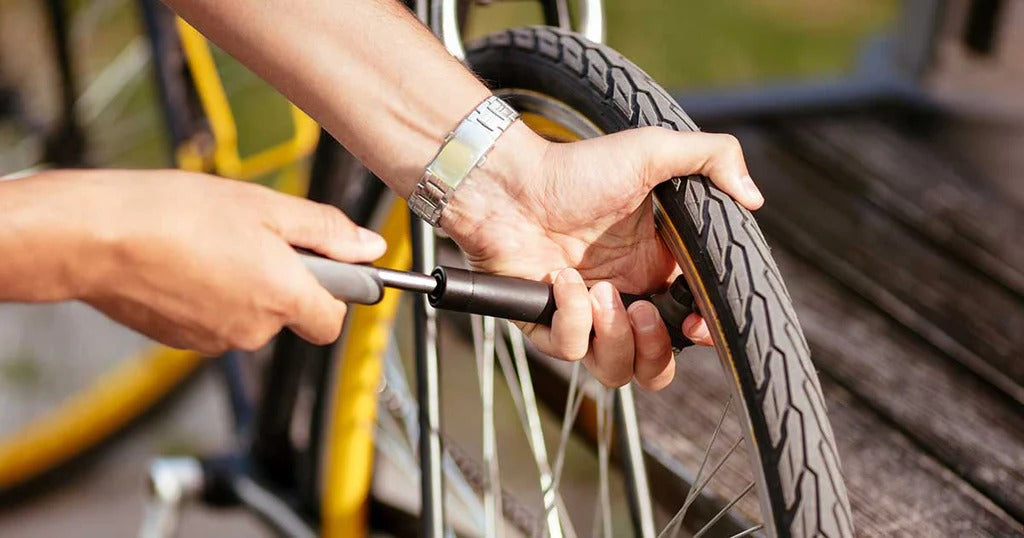
What is the correct tire pressure for the racing bike?
Sometimes the smallest changes have the biggest impact... The biggest performance improvement you can make on your road bike isn't lighter parts or an advanced diffuser. It is the pressure of your tires. If you don't pay attention to tire pressure, the amount of air in your tires is probably not ideal and downright bad. Incorrect tire pressure leads to flat tires and reduced comfort. Therefore, read the tips below to find the perfect tire pressure for your racing bike.
Pump up your tires
With the right tire pressure, your bike rolls quickly and smoothly, you sit comfortably and you prevent flat tires. Narrow tires need more air pressure than wide tires: racing bike tires usually need 5.5 to 8.5 bar.
Pssst... the word bar comes from the Greek word báros (heaviness). It is a practical unit used in industry and daily life. Fun fact: there is always pressure around us. The standard ambient pressure at sea level is equal to 1 bar.
The ideal tire pressure depends on your weight. The heavier you weigh, the higher your tire pressure should be. For example: a cyclist weighing 75 kg can use 7.5 bar on his racing bike. Then a 90 kg cyclist should have around 8.5 bar and a 60 kg rider can already cycle with 6 bar. It is important to mention that you never exceed or fall below the tire pressure recommended by the manufacturer. This is stated on the side of the tire.
Check the tire pressure of your bicycle regularly
Tires always leak air over time. Lucht sijpelt uit alle banden, hoe goed en duur dan ook. This can range from a few half bars per week to drastic drops overnight. Air loss increases when there is pressure on the tire or when the temperature drops significantly. For every 10 °C degrees that the temperature drops, approximately 2% of air disappears from the tire. Some cyclists check the tire pressure before every ride, others once a week. The most important thing is that you develop a habit of regular checkups that works for you. If you don't do this, you will probably often drive with the wrong tire pressure.
Have you repaired your tire with a CO2 canister during a ride? Then check the tire pressure again after an hour. Carbon dioxide penetrates the tire even faster than air.
Find the correct tire pressure
Tire pressure is not something you can set and forget. It is often thought that higher tire pressure equals lower rolling resistance, because hard tires deflect less on a slippery road surface and create a smaller contact patch. But no road is perfectly smooth. Properly inflated bicycle tires adapt to bumps and absorb shock. Over-inflated bicycle tires transmit shocks to the cyclist, which is at the expense of speed and riding comfort. On a new road surface your tires might feel great at 7.5 bar, but on a rough road they might roll faster at 7 bar. In wet conditions you can use 0.5 to 1 bar less than normal for better road grip.
Do not over-inflate
More is not always better! The general trend is to increase tire pressure frequently. The maximum tire pressure stated on the side of the tire is a maximum and usually too high to drive. Furthermore, it does not take into account factors that influence tire pressure, such as the size of the rider and the terrain. Especially if you've recently switched to wider tires, are about to embark on a ride full of turns and switchbacks, or are riding on surfaces like chip seal, you'll want to lower your pressure. Although rolling resistance increases with lower tire pressure, several studies show that the rolling resistance of various road tires increases only slightly, on the order of a few watts of power, even at tire pressures of up to 6 bar on standard road tires. Also remember that rolling resistance is only a fraction of the forces we have to overcome (the majority is wind resistance or, on hills, gravity). The biggest differences in rolling resistance are not in the tire pressure, but in the tire you use. Read here how to choose the right tire for your racing bike.
Road bike tire pressure overview
|
Bandwidth |
Body weight (KG) |
||||||
|
<55 |
60 |
65 |
70 |
75 |
80 |
85+ |
|
|
23mm |
6 |
6,5 |
7 |
7,5 |
8 |
8,5 |
8,5 |
|
25mm |
5,5 |
6 |
6,5 |
7 |
7,5 |
8 |
8,5 |
|
28 & 32mm |
4 |
4,5 |
5 |
5,5 |
6 |
6,5 |
8 |
Beware of the floor pump
If you inflate your tires with a floor pump, the gauge probably won't be as accurate. Floor pump gauges measure the pressure at the gauge, so they measure the air pressure in the pump, not in the tire. And the quality of the meter varies - it may be off by a few points. The good news is that most meters are at least consistent, even if not completely accurate; So you pump up to the same pressure every time. As a solution, you can purchase a separate meter. A needle gauge is affordable, accurate and durable.
Play with different tire pressures
It is quite common to inflate the front and rear tires identically. But your weight balance is not 50% front and 50% back. For cyclists it is in most cases 40% front and 60% rear.
Which pressure you prefer depends on a number of factors, such as your tire choice and driving style, but it is also clear that you should not maintain the same pressure at the front and rear. If you weigh 70kg with a weight distribution of 40-60, that is 42kg on the rear wheel and 28kg on the front wheel. It is therefore logical that you should apply proportionately less pressure at the front. It won't be 50% less, but it's not unreasonable to think it could be 15 to 20% less.
Experiment with tire pressure by deflating the front and rear tires about 5% each (percentage, not bar, as front and rear tires are different and should be changed proportionately). Start riding and notice how it feels, and don't be afraid to lower it a little more. The ideal tire pressure gives you a comfortable ride with a confident feeling in the corners. As soon as the front wheel feels even a little bit restless in sharp bends, increase the tire pressure by a few percent. Measure the front and rear pressure with your gauge and record this as a baseline, but remember that perfect pressure can change depending on conditions, terrain, weather and if you change tire size or brand.
Would you like to read more about (racing) bicycles?
Sign up for the newsletter and receive interesting information.



Leave a comment
This site is protected by hCaptcha and the hCaptcha Privacy Policy and Terms of Service apply.