

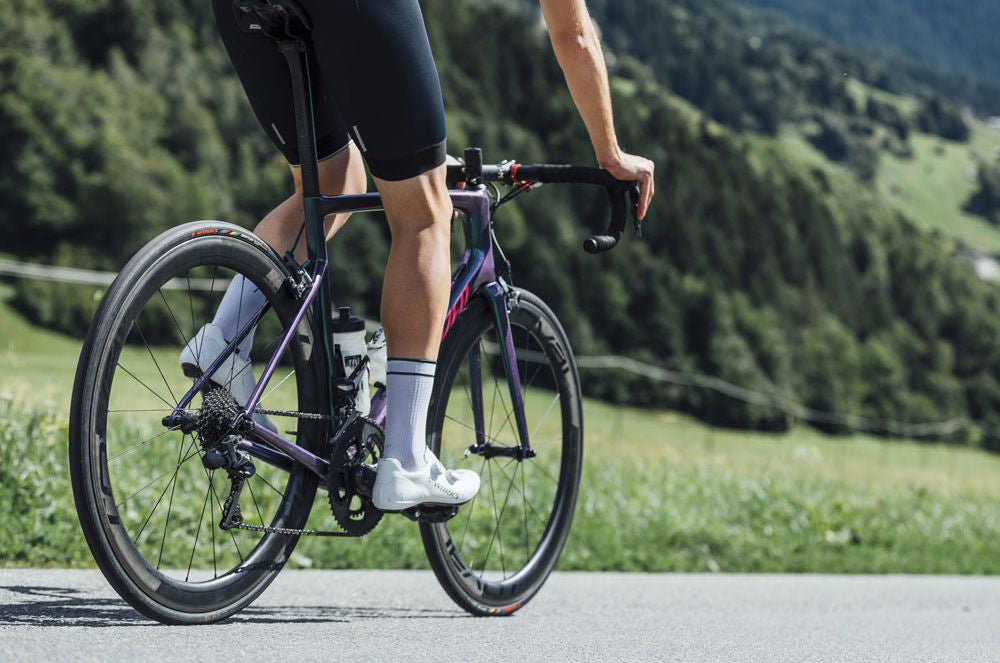
What is RPE (Rate of Perceived Exertion) and how do you use it while cycling?
When reading about training, you’ll sometimes come across the term RPE - Rate of Perceived Exertion Scale. This is a scale that runs from 1 to 10 and is used to estimate your training intensity based on how it feels. So it’s a subjective measure to indicate how easy or difficult you find the activity you’re doing. On the scale, 0 stands for rest and hardly any effort, and 10 stands for maximum effort.
|
RPE scale |
RPE effort |
Description |
|
10 |
Maximum |
Completely out of breath, unable to talk. You can only sustain it for a very short time. |
|
9 |
Very hard |
Almost as hard as you can push on the pedals. |
|
7-8 |
Hard |
When riding hard, you can only hold this for a few minutes and can only communicate in one-word answers.
|
|
4-6 |
Moderate |
Clearly riding faster but still able to talk. |
|
2-3 |
Easy |
Getting up to make a cup of tea. Up to very relaxed riding. |
|
1 |
Rest |
Sitting on the couch and doing nothing. |
It’s also important to be aware of cadence, the speed at which your legs turn, expressed in revolutions per minute (rpm). Many beginner cyclists make the mistake of not using their gears properly and riding at too low a cadence. The easiest way to measure cadence is to buy an (inexpensive) speed/cadence sensor and mount it on your bike. This also lets you see how far you’ve ridden. Another option is to occasionally count the number of pedal revolutions of one foot in 15 seconds and then multiply by four to calculate your per-minute cadence.
As a beginner, it can sometimes be difficult to judge how best to start training and use RPE. In the blog How do you start cycling training? we explain more about getting started with cycling and the right training approach.
Using perceived exertion during training and racing
Rating perceived exertion is useful for every type of effort and is often the best metric to use during races. Curious about how many calories you burn during road cycling? Then read the blog about calorie burn while cycling.
Using RPE with power, heart rate and pace
Power meters give cyclists an accurate and direct measure of workload. Runners, triathletes, and cyclists can use heart rate monitors, continuous glucose monitors, and wearable trackers for sleep, recovery, hydration, blood glucose levels, and more. As a result, some athletes tend to look only at computer data. But research shows that perceived RPE is actually an incredibly strong indicator of performance.
Cycling power meters make RPE more important than ever. While it’s true that 200 watts today is the same load as 200 watts tomorrow, RPE adds valuable context to power files. If you’re fresh, 200 watts may feel like a moderate spin. If you’re fatigued, it can feel like you’re working harder than usual. Athletes use terms like 'sluggish,' 'heavy legs,' and 'pedaling through peanut butter' to describe those same 200-watt efforts.
In the same way, RPE provides context for heart rate and pace data. A pace of 8 minutes per kilometer may feel sustainable one day, but on another day it can feel just as hard as race pace.
RPE is a strong warning system for revealing fatigue; your body is telling you it can still get the job done, but that even though the work being done is the same, the effort required to complete it is greater.
Measuring Training Progress with Perceived Exertion
RPE can show progress even without a change in your power or pace. At the start of the season, for example, a 20-minute climb at an average power of 250 watts may feel hard enough to rate as a 7 or even an 8. Later in the season, as your fitness improves, that same climb at 250 watts may feel less demanding and more like a 6. An RPE of 7 to 8 for the climb may eventually be 275 watts at peak season.
Racing by Feel: RPE in Competition
We include RPE values with every workout in our library, and athletes should note subjective information in their training logs. Not only is perceived exertion important for adding context to power and heart rate files, but it also helps athletes learn to judge intensity levels accurately when all other technology is unavailable.
During races, RPE is often the most accurate and realistic way to measure intensity. For example, we know that power output starts to decline at elevations between 5,000 and 6,000 feet above sea level. Core temperature, fatigue, caffeine, and stress affect the heart rate response to effort.
One of the main goals we set when working with athletes is to teach them to train and race by feel. Athletes often deliver their best performances when they tune into their bodies instead of looking at the numbers. Keep recording the data so you can review it later and so we have it for your long-term training history. But in the moment, you want to be able to capture strength, power, and heart rate values without even looking at a display.
The hallmark of an experienced athlete is learning to use technology effectively while also reducing your dependence on it.
Want to read more about cycling training?
Sign up for the newsletter and receive useful information about health, training, and cycling.

Leave a comment
This site is protected by hCaptcha and the hCaptcha Privacy Policy and Terms of Service apply.