

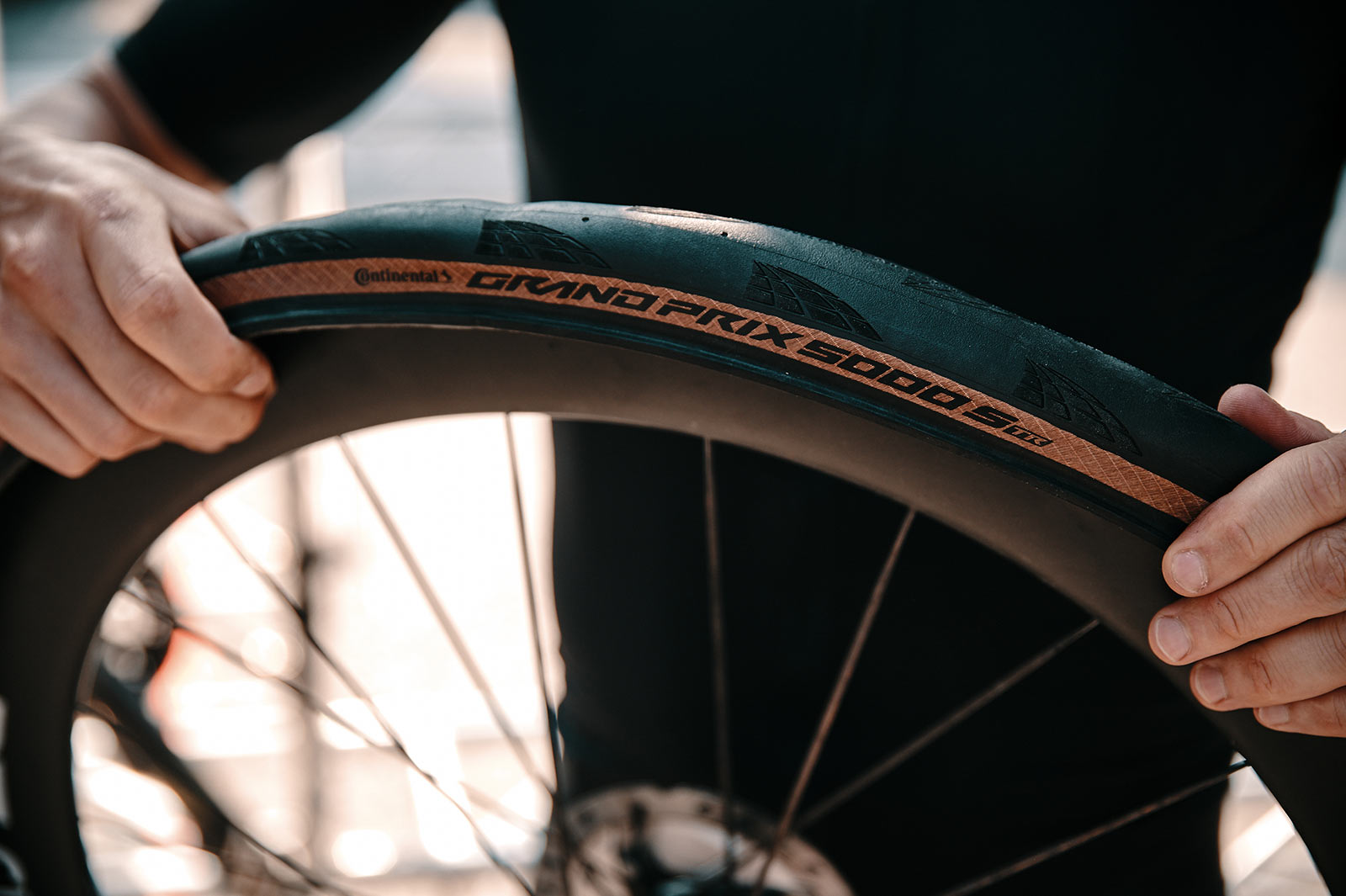
What should you look for when choosing bike tyres?
Your bike’s tyres are without a doubt one of its most important components. They affect your performance, ride comfort, and safety. A budget bike with good tyres and the right tyre pressure can sometimes ride better than an expensive bike with the wrong tyres. In this article, we take a closer look at tyres for the road bike. features of road bike tyres are their narrow profile and smooth tread. That combination creates lower rolling resistance and therefore better performance on the bike.

Tyre width
As a rule, the narrower the tyre, the less contact it has with the ground. So the faster you go. Tyre widths range from 19 to 100 mm. The narrowest tyres are used for track cycling. And the widest tyres are used for demanding mountain bike riding. On the road bike, there are generally three standard tyre widths: 23, 25, or 28 mm. A few years ago, the 23 mm tyre was the most popular. In recent years, the 25 mm tyre has been seen as the standard road bike tyre. By now, we’re seeing a shift towards the 28 mm tyre.
So the narrower the tyre, the faster you go. Why, then, are riders increasingly choosing a slightly wider tyre these days? There’s a clear reason for that. With the rise of increasingly lighter but also stiffer materials, such as carbon, the road bike has become less comfortable. The steel frames of the past were less light and less fast, but they absorbed vibrations well. The solution is a wider tyre. That way, the tyre increases not only in width but also in height. The extra height absorbs more vibrations and irregularities in the road surface. So they are not passed on to the rider. A wider tyre therefore provides more comfort. Do you have an older road bike? Then you may still need to buy a 23 mm tyre for it.
TL;DR
- Three standard widths for road cycling: 23, 25 and 28 mm.
- Tyre width affects resistance.
- Stiffer road bike materials reduce comfort.
- A wider tyre offers more comfort.
- The modern standard width is 25 or 28 mm.

Tyre resistance
In the previous section, we saw that tyre width affects resistance. And the lower the resistance, the less energy you need to move forward. Tyre resistance is a complex (physics) topic. In this article, we discuss: rolling resistance, air resistance, and friction resistance.
Rolling resistance of a tyre
What exactly does rolling resistance mean? It is the loss of energy while the wheel is turning and through friction with a surface. In other words, the force that is lost through the contact between the tyre and the ground. The larger the area of the tyre that touches the ground, the more energy it takes to move forward. The main factors that affect rolling resistance are: tyre pressure, tyre width, and tread.
Tyre pressure
Tire pressure is important for several reasons. As you just read, the right tire pressure reduces rolling resistance. That means you need less energy to achieve the same drive - speed. Just don’t inflate your tires too hard. If you do, you sacrifice comfort and your ride will feel less enjoyable than when you ride at the correct pressure. Tires that are too hard also increase the chance of getting a puncture. On the other hand, tire pressure that is too low reduces speed. A tire that is too soft also wears out faster. A shame! So how hard should you inflate your bike tires? An average road bike tire needs between 6 and 8 bar.
Tire width
Earlier in the article, we already looked more closely at bike tire width. There, we stated that the wider the tire, the higher the rolling resistance. In principle, this is correct, but there is a small nuance. A wider tire does not always create a larger contact patch with the ground. A wide tire is wide and short, while a narrow tire is narrow and long. Although the contact patch stays the same, a wider tire holds more air.
Tread
You’ve probably noticed it. Road cyclists ride tires with minimal tread, while mountain bikers use tires with much more tread. The less tread a bike tire has, the lower the resistance. But also the lower the grip. So a tire with little tread is designed for a (relatively) smooth surface, such as asphalt. The more tread a tire has, the better it performs on rough terrain. That’s why mountain bikers ride with aggressive tread, to maintain as much grip as possible on rough terrain. For gravel biking, the tire tread sits somewhere between that of a road bike and a mountain bike. Gravel riders aim for the speed of road cyclists with a narrow tire, while also wanting more grip. That’s why a gravel bike tire has a coarser tread than a road bike.
A road cyclist’s aerodynamic drag
There is a linear relationship between rolling resistance and speed. But an exponential relationship between aerodynamic drag and speed! Once your rolling resistance is dialed in, it becomes extremely important to pay attention to your aerodynamic drag. Many cyclists claim that reducing aerodynamic drag only makes sense at higher speeds (+40 km/h). Because aerodynamic drag increases exponentially, there is some truth to that. If you increase your speed from 20 km/h to 40 km/h, the aerodynamic drag is not twice as high, but eight times as high. Still, it also pays off to work on your aerodynamics at lower speeds. The following factors have the greatest impact on your aerodynamics: bike, outfit, and riding position. An [aerodynamic outfit], for example, will help you save energy.
Friction resistance of a bicycle tire
Friction resistance includes the rotating parts of a bike that create resistance. Think, for example, of the chain, the derailleur, and the cogs. If you ride with high-quality components, friction resistance is often of secondary importance. The rotating parts of a bike, for example those involved in the drivetrain (chain), also create resistance. But this friction resistance is of minor importance in the total resistance while cycling.
TL;DR
- The main factors affecting rolling resistance are: tire pressure, tire width, and the tread of the bike tire.
- Tyre pressure that’s too high (the tyre is too hard) reduces comfort on the bike. It also makes the tyre more prone to punctures.
- Tyre pressure that’s too low (the tyre is too soft) means you have to push harder to keep moving. On top of that, the tyre wears out much faster.
- The less tread a tyre has, the lower the rolling resistance. But it also means less grip on the road.
- Reducing aerodynamic drag is always worthwhile. Even at lower speeds.
- Frictional resistance plays a minor role in total resistance.

Resistance to punctures
Flat tyres are always frustrating. Fortunately, you have a big influence on how often you puncture. Material choice plays a role, but so do your riding style and how regularly you check your tyres.
Tyre pressure
Tyre pressure is one of the most important factors. Not only does it have a big impact on your performance and resistance, but the right tyre pressure also helps prevent punctures. If the pressure is too low, small stones can easily get trapped between the rim and the tyre. Tyre pressure that’s too low also causes the rubber to wear faster and makes it more vulnerable to sharp objects. If the tyre pressure is too high, the tyre needs a smooth surface. That’s why it’s better to lower the tyre pressure slightly on routes with a lot of uneven surfaces, such as stones, potholes and bumps.
Quality of the tyres
A good tyre features a puncture-protection layer. Specially designed road bike tyres, mountain bike tyres or gravel bike tyres from a good brand come with the right level of puncture protection. In addition, there is often a marking on the tyre that shows whether it needs replacing. These are two small holes positioned a few centimetres apart. When both holes are worn away, the tyre needs to be replaced.
Check the tyre and rim regularly
Possibly one of the most important ways to prevent punctures: checking! Inspect your outer tyre, inner tube and rim regularly. A worn rim can cause you to puncture often. And an old inner tube has a greater chance of going flat.
TL;DR
- The right tyre pressure helps prevent punctures.
- The quality of the tyres has a major impact on how often you puncture.
- Check your inner tube, tyre and rim regularly.
Would you like to read more articles about road cycling?
Sign up for the newsletter and receive the best blogs!





Leave a comment
This site is protected by hCaptcha and the hCaptcha Privacy Policy and Terms of Service apply.